
Table of Contents
- What to Include in a 504 Plan: Core Components
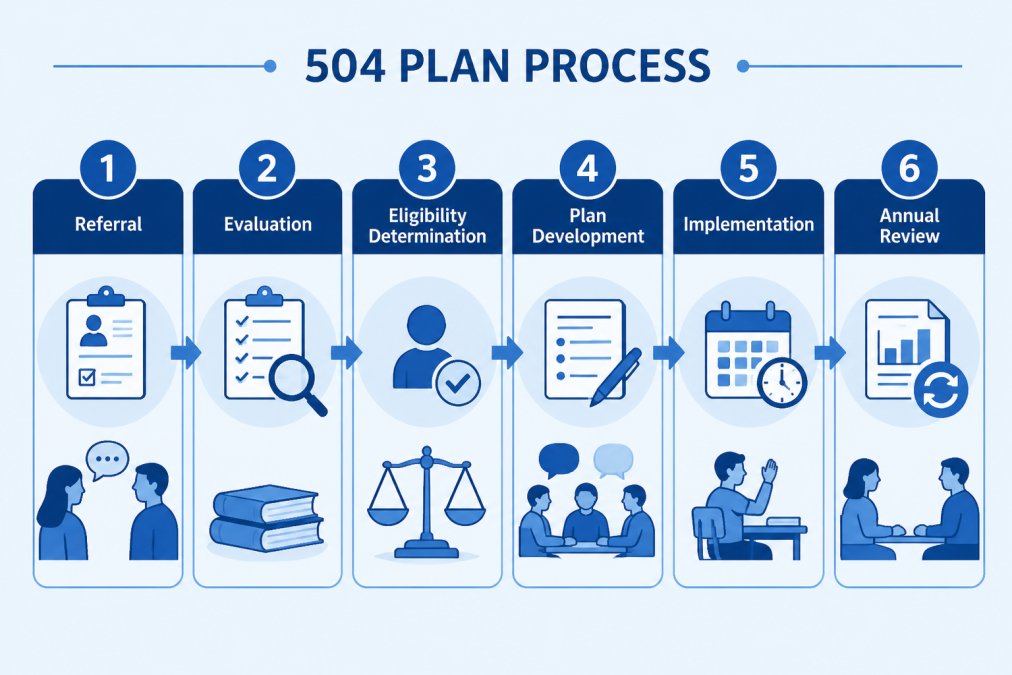
- How to Request a 504 Plan: Steps for Parents
- 504 Plan Meeting Checklist: What to Bring and Ask
- 504 Plan Examples: Sample Accommodations by Need
- 504 Plan Accommodations List: Classroom, Testing, and Beyond
- Writing Accommodations That Are Observable and Consistent
- Monitoring Progress and Handling Implementation Issues
- Conclusion: Building a Plan That Works
- Frequently Asked Questions
Last Updated: October 9, 2026
What to Include in a 504 Plan: Core Components
A 504 plan is a written document that gives a student with a disability equal access to the classroom through accommodations, not a separate curriculum.
The core components are consistent across most plans:
- Student and school information - name, grade, school, case manager, and plan date
- Eligibility statement - the disability and the major life activity it limits
- Accommodations - the specific classroom, testing, and health supports
- Service providers - who is responsible for each accommodation
- Review date - when the team will meet again
The federal law behind these plans is short on detail about formatting, which is why two districts can produce very different documents. The U.S. Department of Education guidance on Section 504 describes the obligation to provide a free appropriate public education, but leaves the paperwork to local teams.
How to Request a 504 Plan: Steps for Parents
The fastest way to request a 504 plan is a dated written request to the school, not a hallway conversation.
Here is the sequence we recommend:
- Write a short letter or email stating that you are requesting a 504 evaluation
- Name the concern and how it affects your child at school
- Ask for a written response and a timeline
- Keep a copy of everything you send
A common mistake is waiting for the school to raise the issue first. Schools are not required to evaluate every struggling student, and a teacher may see the difficulty as a motivation problem rather than a disability.
Before the meeting, gather what you already have: report cards, teacher notes, medical or psychological assessments, and any private testing.
504 Plan Meeting Checklist: What to Bring and Ask
Walking into the meeting prepared changes the tone of the conversation. Most guides give you a short list of items to bring. This section gives you a fill-in-the-blank planning tool you can complete before the meeting, so you arrive with a draft plan rather than a vague list of concerns.
Before the meeting: complete this planning worksheet
Copy these prompts into a document and fill them in. Bring the completed worksheet to the meeting.
1. Student snapshot
- Student name: ______ Grade: ______ School: ______
- Case manager (if known): ______
- Date of this meeting: ______
2. The functional barrier (not the diagnosis)
- What does my child struggle to do at school? ______
- Which major life activity does that difficulty affect (learning, concentrating, reading, communicating, walking, seeing, hearing, breathing, caring for oneself, working)? ______
- Where does the barrier show up most (specific class, time of day, setting)? ______
3. Evidence I am bringing
- Report cards or progress reports
- Teacher notes or emails describing the difficulty
- Medical, psychological, or private evaluation
4. Accommodations I want to propose
- Classroom: ______
- Testing: ______
- Health/safety: ______
5. For each accommodation, name the owner
- Accommodation: ______ Responsible role: ______
- Accommodation: ______ Responsible role: ______
- Accommodation: ______ Responsible role: ______
6. Questions I will ask
- Who is responsible for each accommodation?
- How will the school track whether it is working?
- What happens if a teacher does not follow the plan?
7. Student voice
- In my child's own words, what is hardest at school? ______
- What does my child say would help? ______
What to bring to the meeting
- Copies of your written request and any school replies
- Medical records, psychological assessment, or academic data
- Your completed planning worksheet
What to ask during the meeting
- Who is responsible for each accommodation?
- How will the school track whether it is working?
- What happens if a teacher does not follow the plan?
After the meeting
- Request a copy of the written plan
- Confirm the review date in writing
- Note who to contact if an accommodation is not delivered
Student participation matters more than many parents expect. A middle or high school student who can describe their own needs gives the team better information and starts building self-advocacy skills they will use for years. If your child is not ready to speak in the meeting, their written answers on the worksheet can be read aloud on their behalf.
504 Plan Examples: Sample Accommodations by Need
Accommodations should match the specific limitation, not the diagnosis label. Two students with the same condition may need very different supports.
For attention and focus:
- Preferential seating near the teacher or away from distractions
- Extended time on assignments and tests
- Frequent breaks during long tasks
For anxiety and emotional needs:
- A quiet space to reset when overwhelmed
- Advance notice of schedule changes
- Reduced homework load during flare-ups
For sensory and physical needs:
- Access to a water bottle, snacks, or movement breaks
- Written copies of verbal instructions
- Extra time for transitions between classes
For handwriting and writing:
- Use of a keyboard or speech-to-text
- Copies of class notes
- Reduced copying from the board
Your child's plan may combine supports from several categories. The goal is a short list the team can actually deliver, not a long list that looks thorough on paper and falls apart in practice.
504 Plan Accommodations List: Classroom, Testing, and Beyond
A strong 504 plan accommodations list covers three settings: the classroom, testing, and everything outside the room.
IEP & 504 Advocacy Kit for Parents →
| Setting | Example Accommodations | Who Delivers It |
|---|---|---|
| Classroom | Preferential seating, extended time, breaks, note copies | General education teacher |
| Testing | Extended time, separate room, calculator, oral directions | Test coordinator |
| Health | Medication access, water, restroom breaks | School nurse |
| Beyond the room | Field trip supports, extracurricular access, remote learning | Case manager |
Non-classroom settings are the ones most often left out. If your child needs a support on a field trip, during remote learning, or in an after-school activity, write it into the plan. An accommodation that only exists in one classroom is not equal access.
Writing Accommodations That Are Observable and Consistent
The difference between a plan that works and one that collects dust is how the accommodations are written. Vague language gives everyone room to interpret the support differently. This section gives you a framework for writing accommodations that any observer could confirm happened, and that a school can document.
The five-part accommodation formula
Every accommodation should answer five questions:
- What is the support? (the specific action)
- Who delivers it? (a role, not a name that changes)
- Where does it apply? (classroom, testing room, cafeteria, bus, field trip)
- When or how often? (every test, daily, as triggered by a specific condition)
- How is it documented? (teacher log, test cover sheet, case manager check-in)
If any of the five is missing, the accommodation is hard to monitor.
Weak versus strong wording
Weak: "Student will receive extra help as needed." Strong: "Student will receive extended time of 50% on all tests and quizzes, arranged by the test coordinator, documented on the test cover sheet."
Weak: "Reduced homework." Strong: "Homework will be reduced to the essential practice problems, no more than 20 minutes per subject, determined by the classroom teacher and noted in the weekly assignment log."
Three rules for every accommodation
- Use a number or a clear condition instead of "as needed."
- Name the person or role responsible.
- Describe what the student experiences, not the teacher's intention.
How implementation gets documented
A plan is only as strong as the record behind it. Ask the team to agree on a simple documentation method for each accommodation:
- Teacher log: a running note of when the accommodation was used
- Test cover sheet: a checkbox confirming extended time or separate setting
- Case manager check-in: a monthly or quarterly review with the student
You do not need a complicated system. You need a method the school will actually use and that you can request to see.
A note on "as needed"
Some accommodations genuinely depend on a condition, a health accommodation for a seizure, for example, cannot be scheduled. In those cases, write the trigger instead of "as needed": "When the student reports or shows signs of an oncoming seizure, the nurse will..." A trigger is observable. "As needed" is not.
Monitoring Progress and Handling Implementation Issues
A 504 plan is a living document, and the annual review is the floor, not the ceiling. You can request a review any time the supports stop working.
Watch for these signs the plan is not being followed:
- Your child says a support "does not happen" in a specific class
- Grades drop in one subject while holding steady elsewhere
- Your child avoids a class or reports feeling singled out
When something is not being implemented, start with a written note to the case manager describing what you observed and when. The Office for Civil Rights complaint process is available if a school repeatedly fails to implement the plan, though most issues resolve at the school level with clear documentation.
For families who want a structured way to prepare, The Simple Guides offers an IEP & 504 Advocacy Kit for Parents with a pre-meeting worksheet, a notes template, and an action tracker. If you are also working on daily routines at home, the Parent & School Support Bundle pairs the advocacy kit with the ADHD Executive Function Starter Kit for Students.


Conclusion: Building a Plan That Works
A 504 plan only helps when the accommodations are specific, owned by a named person, and reviewed on a real schedule.
At The Simple Guides, we build plain-language tools for exactly this moment: a pre-meeting worksheet to organize your priorities, advocacy scripts for the hard parts of the conversation, and a post-meeting tracker so nothing gets lost after the meeting ends.
Frequently Asked Questions
What should be included in a 504 for ADHD?
A 504 plan for ADHD should include accommodations that address attention, organization, and impulse control. Common items include extended time on tests, preferential seating near the teacher, frequent breaks, a quiet space for testing, and a homework plan that breaks assignments into smaller parts. The plan should also list who is responsible for each accommodation and how progress will be tracked. Because ADHD affects students differently, the specific accommodations should match your child's evaluation results and daily challenges.
Do 504 plans excuse absences?
504 plans do not automatically excuse absences. However, if a student's disability causes frequent absences related to a medical or mental health condition, the plan can include accommodations for making up missed work, extended deadlines, or a reduced homework load during absences. Some plans also specify that absences related to the disability should not count against attendance awards or truancy thresholds. The school team decides what is appropriate based on the student's needs and the district's policies.
Is there a downside to having a 504 plan?
A 504 plan provides legal protections and ensures your child receives needed accommodations. Some parents worry about stigma, but accommodations are common and designed to level the playing field. A 504 plan does not appear on transcripts or permanent records. The main consideration is that the plan must be followed, so it should be reviewed regularly to ensure it still matches your child's needs. If a school does not implement the plan, you have the right to request a meeting and seek resolution.
What are some examples of 504 accommodations?
Examples of 504 accommodations include extended time on tests, preferential seating, breaks during class, use of a calculator, reduced homework load, oral testing instead of written, note-taking support, and access to a quiet room for test-taking. Other examples are extra time for transitions, behavioral support plans, and health-related accommodations like allowing water bottles or frequent bathroom breaks. The right accommodations depend on the student's disability and how it affects major life activities like learning, reading, or concentrating.
Who should be involved in creating a 504 plan?
The 504 team typically includes the student's parents or guardians, a school administrator, the student's general education teacher, and a school staff member who can interpret evaluation results, such as a school psychologist or counselor. The student should participate when age-appropriate. Others may be invited if they have relevant knowledge, such as a nurse, therapist, or special education teacher. The team works together to review documentation, determine eligibility, and design accommodations that address the student's individual needs.
How specific should accommodations in a 504 plan be?
Accommodations should be specific enough to be observable and consistently implemented. Instead of writing 'extra time on tests,' specify '50% extended time on all classroom and standardized tests.' Instead of 'preferential seating,' specify 'seating in the front row, away from doors and windows.' Include who provides the accommodation, when it applies, and how it will be monitored. Specific language reduces confusion and makes it easier to hold the school accountable if the plan is not followed.
How often should a 504 plan be reviewed?
A 504 plan must be reviewed at least annually, but you can request a review at any time if your child's needs change. Many schools schedule a review at the start of each school year or when a student moves to a new building. If your child is not making progress or the accommodations are not working, request a meeting to update the plan. Regular reviews ensure the plan stays current and effective.
What should parents bring to a 504 plan meeting?
Parents should bring any medical or psychological documentation, a list of their child's strengths and challenges, examples of what is and is not working at home, and a written list of desired accommodations. It also helps to bring a notebook or template for taking notes, a copy of the current 504 plan if one exists, and a list of questions. Being organized helps you participate fully and ensures your concerns are addressed.